Dissecting the core of how humans naturally learn, think, and choose to act, internationally-recognized critical thinking leader Linda Elder illuminates root causes of dysfunctional thought and shows us how to free ourselves from both selfishness and groupthink through explicit tools of rationality.
This miniature guide, which has sold more than half a million copies, is widely used in teaching and learning, in personal and professional life. It distills the essence of critical thinking into a 24-page, pocket-sized guide. It introduces the interrelated complex of critical thinking concepts and principles implicit in the works of Richard Paul and Linda Elder. This guide is widely used at the college level. It can be used as a critical thinking supplement to any textbook or course.
The main goal of Critical Writing is to provide students with a set of robust, integrated critical concepts and processes that will allow to them think through and write about a topic in a way that is built on — and permeated by — substantive critical thinking.
The Critical Thinker’s Guide to Bias, Lies, and Politics in the News reveals the power of critical thinking to make sense of overwhelming and often subjective media by detecting ideology, slant, and spin at work.
The purpose of this guide is to help you begin to understand history as a way of thinking, as a system of understandings. History is not a list of dates, names, and events to store up in your memory. It is a catalog of stories told about the past that, when told and understood insightfully and deeply, can help us live better in the future.
This guide is designed principally for instructors. It is also useful for those interested in a serious study of history. It presents history as a mode of thinking rather than a list of disconnected dates and names and places. We recommend that it be used in conjunction with the student guide: Understanding Critical Thinking as the Key to Historical Thinking.
This guide focuses on the intellectual skills that enable one to analyze anything one might think about - questions, problems, disciplines, subjects, etc. It provides the common denominator between all forms of analysis.
This Thinker's Guide was created specifically for the aspiring young learner, however the content and approach are applicable to students and people of all ages. This guide introduces critical thinking concepts and provides strategies for developing one's own critical thinking process. Its full color images and glossy format help capture the attention of the teenage or pre-teen student while focusing on the essence of critical thinking as it applies to today's world. The skills implicit in this guide apply to all subjects. Teachers can use it to design instruction, assignments and tests in any subject. Students can use it to improve their learning in any content area.
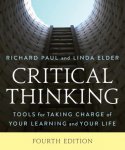
Written by two of the most prominent leaders in the International Critical Thinking movement, Richard Paul and Linda Elder, this is the text that will give students the tools they need to achieve deep and significant learning in all disciplines and subjects, as well as in life. It is also a useful book for anyone interested in developing as thinker.
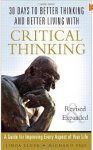
Critical thinking is at once simple and complex. Though there are many layers to critical thinking, and you can always deepen your understanding of it, there are some basic ideas in critical thinking that, if taken seriously, can almost immediately improve the quality of your life. This book offers 30 such ideas. You can focus on one idea per day or one idea per week. And each idea is immediately applicable to your life. This book is for anyone interested in improving the quality of their lives by improving the quality of their thinking.
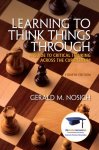
Built on Richard Paul's model of critical thinking, Learning to Think Things Through, was written to help students engage in critical thinking within the discipline or subject matter they are studying.
Like its parent text, Critical Thinking: Tools for Taking Charge of Your Learning and Your Life, Second Edition, this book focuses on an integrated, universal concept of critical thinking that is both substantive and practical; it provides reader with the basic intellectual skills they need to think through content in any class, subject, discipline, and through any problems or issues they face.
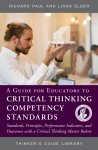
The critical thinking competency standards articulated in this guide serve as a resource for teachers, curriculum designers, administrators and accrediting bodies. The use of these competencies across the curriculum will ensure that critical thinking is fostered in the teaching of any subject to all students at every grade level. This guide provides a framework for assessing students’ critical thinking abilities. It enables administrators, teachers, and faculty at all levels to determine the extent to which students are reasoning critically within any subject or discipline.
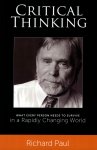
In this anthology of his major papers, Richard Paul explains how to help students become intellectually fit, how to build the intellectual muscle to overcome inherent self-deceptive tendencies and rise to the challenges of a rapidly changing world.
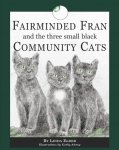
This is the story of Fairminded Fran and her experience in learning about community cats.
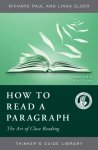
This guide provides theory and activities necessary for deep comprehension. Imminently practical for students.
An original approach to the identification of fallacies focusing on their relationship to human self-deception, mental trickery, and manipulation. Introduces the concept of fallacies and details 44 foul ways to win an argument.